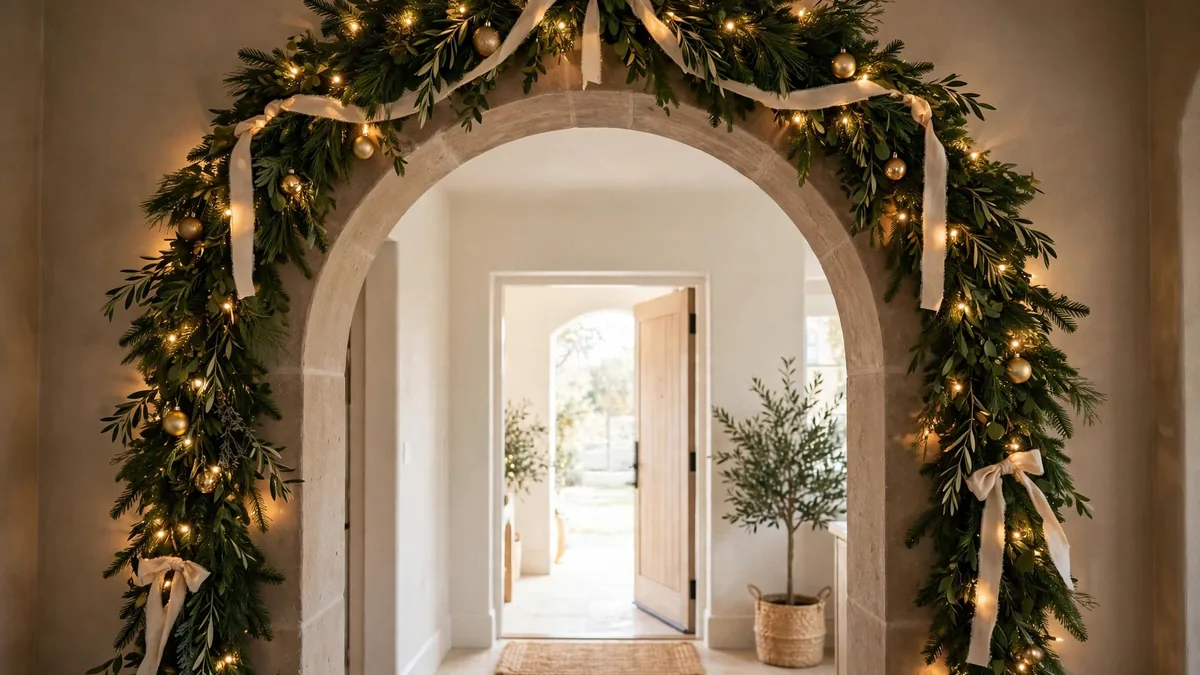
Christmas garland ideas for doorway decorating fail most often before a single branch goes up: the garland is too short, the swag pulls flat, or the hooks give way on the second day. The fix is not a stronger hook. It is measuring first, choosing the hanging method for your frame, and only then choosing a style. These christmas garland ideas for doorway openings follow that order: exact lengths first, a straight hanging-method comparison second, and then 16 styles that work with those measurements, not against them.
I learned the measuring lesson the hard way, and it is why this post starts with a tape measure instead of a shopping list. Two Decembers ago I bought a beautiful 6-foot garland for a 36-inch doorway, hung it in one neat swag, and watched it pull tighter and flatter every time someone brushed past it. By Christmas Eve it looked like a green rope. A 36-inch opening needs about 6 feet just for a gentle top swag with tails, and I had used every inch with nothing left for drape. Now I measure the opening, add the drape, and only then buy — and nothing in this house has sagged since.
How Much Garland Does Your Doorway Actually Need?
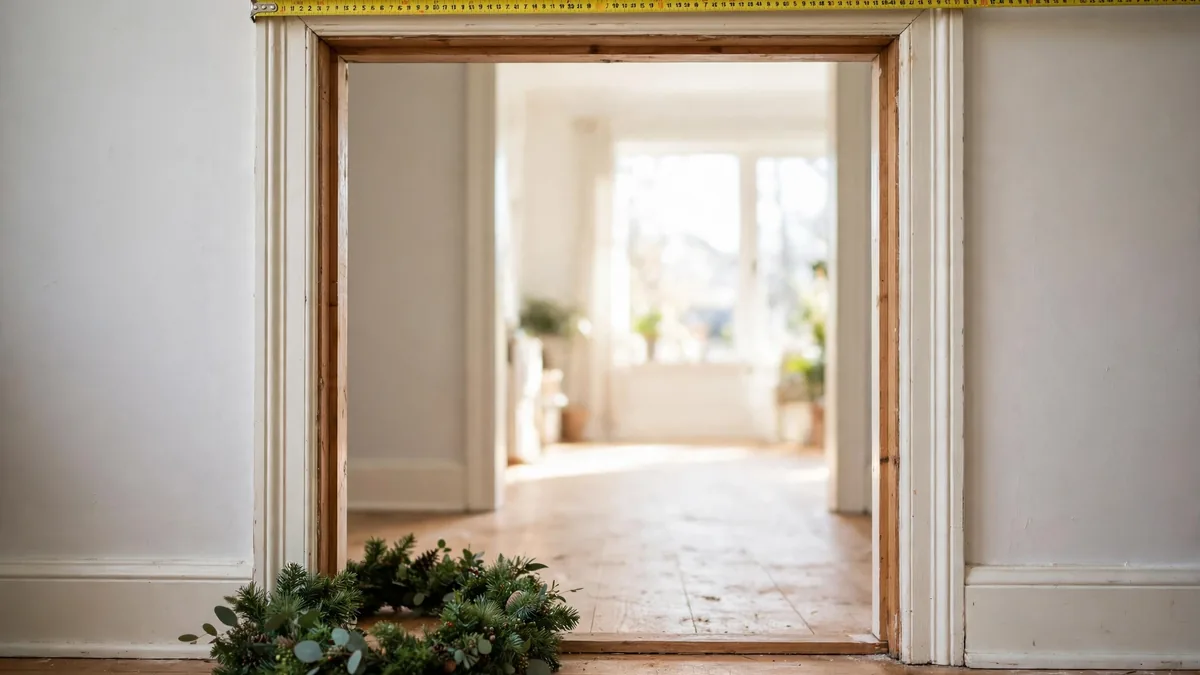
Measure the width at the top, where the garland will sit, not at the floor. Frames are rarely perfectly square, so measure twice — once at the top and once halfway down — and use the wider number. Then pick a shape, because each shape needs a different length. These christmas garland ideas for doorway openings all use the same rule: a top swag needs the opening width plus about 24 inches, roughly 12 inches of drape on each side, so the swag can dip without pulling tight.
| Doorway or arch | Top swag only (buy this) | Full frame: up one side, across, down the other |
|---|---|---|
| Narrow interior, 30 in wide, 80 in high | 5 ft | 15 ft 10 in (two strands joined) |
| Standard interior, 32 in wide, 80 in high | 5 ft 6 in | 16 ft (two strands joined) |
| Standard, 36 in wide, 80 in high | 6 ft | 16 ft 4 in (two strands joined) |
| Wide, 42 in wide, 80 in high | 7 ft | 16 ft 10 in (two strands joined) |
| Arch, 36–48 in wide | 8 ft (extra for the curve) | 17–18 ft (two strands joined) |
| Double doorway, 60 in wide, 80 in high | 9–10 ft, or two 6 ft strands | 20 ft (three strands joined) |
A full frame needs the width plus both sides — for a standard 80-inch-high doorway, that is the width plus 160 inches — which is why almost every full frame needs two strands joined in the middle, hidden behind a bow or ornament cluster. For an arch, measure along the curve with a piece of string, not straight across, then add the same 24 inches of drape. If you are between sizes, buy the longer garland: extra length gathers into a fuller swag, but a short garland cannot be stretched.
Tension Rod vs Hooks vs Over-Door: Which Hanging Method Wins?
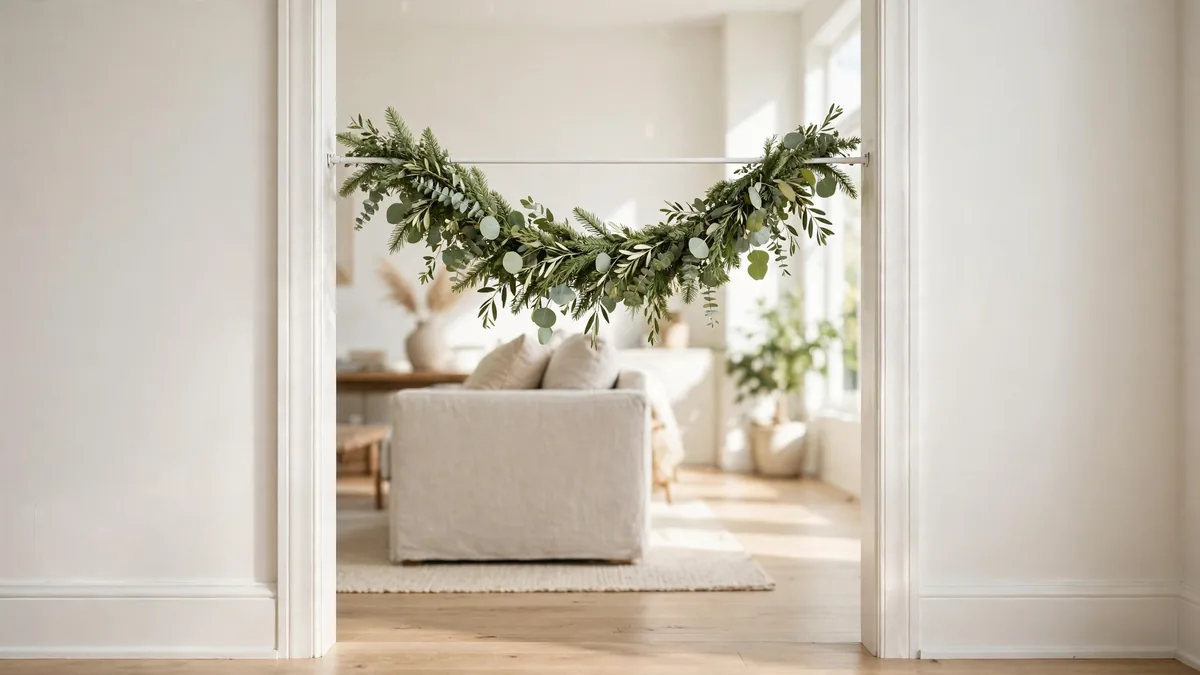
There is no single best method for christmas garland ideas for doorway frames. There is a best method for your frame, your garland’s weight, and whether you rent.
| Method | Best for | Weight it handles | Fails when |
|---|---|---|---|
| Tension rod | Light garlands, narrow frames, renters | About 2–3 lb only | The frame is wider than the rod, uneven, or the garland is heavy or thick-wired pre-lit |
| Adhesive hooks | Most interior doorways, renters, swags and full frames | Large hooks rated about 5 lb each; a doubled 9 ft garland weighs roughly 3–5 lb, so use three hooks | The surface is dusty, cold, or textured; the strip is loaded before its 1-hour cure; all weight hangs on one hook |
| Over-door hooks | Heavy garlands, doors that stay shut | The heaviest of the three, limited mainly by door clearance | The door is used constantly, the frame is too thick, or the hook rattles |
For most readers, adhesive hooks win: three large hooks — one at each top corner and one at the centre — spread the weight and let you shape the swag. A tension rod wins for a light, single swag in a narrow doorway because it leaves no mark at all, but it is not a heavy-garland tool. Over-door hooks win for weight, but test the door’s close before you decorate, not after. Whatever you choose, follow the maker’s instructions for surface preparation and cure time: clean with rubbing alcohol, press firmly, and wait the full hour before hanging, as the Command hook instructions set out. For light safety, use only lights in good condition and never staple through a cord — the UC San Diego decorating safety guide explains why damaged or tacked cords are discarded, not repaired.
Classic Swag and Greenery Ideas
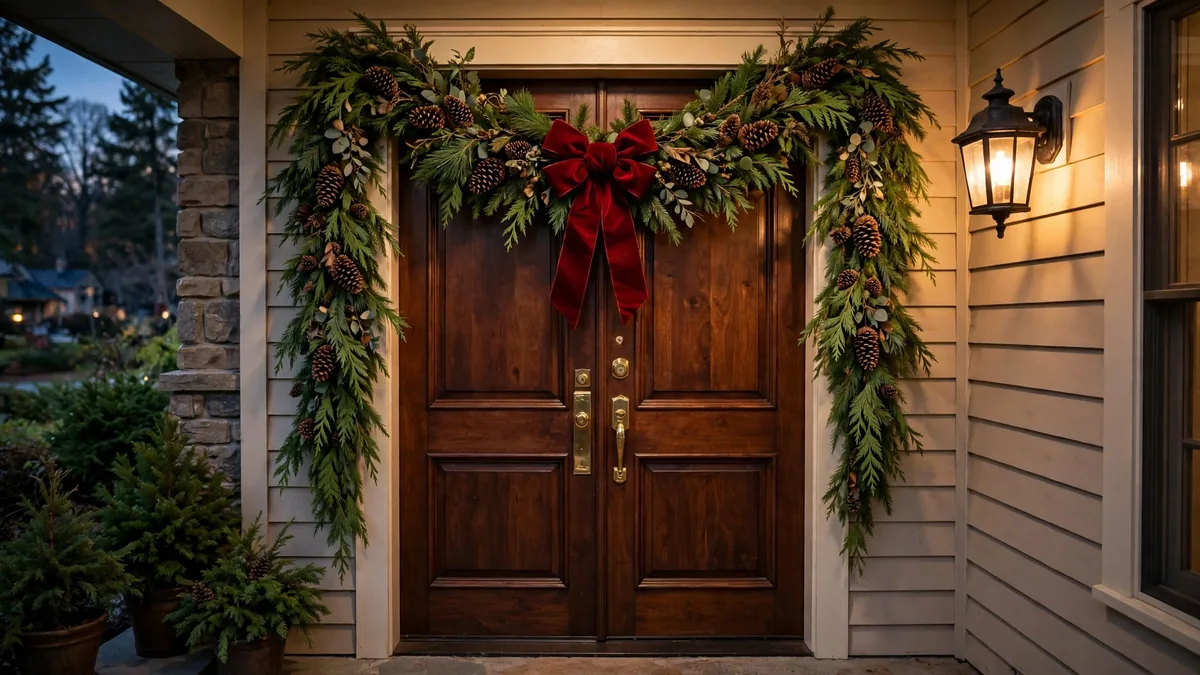
1. The single gentle swag
One 6-foot cedar garland across a 36-inch doorway, dipped about 12 inches in the centre on three adhesive hooks. This is the baseline for all christmas garland ideas for doorway openings, and the one to choose first time. Keep the dip gentle: a deep U looks dramatic on day one and tired by week two, because the centre takes all the weight.
2. The double swag
Two 6-foot garlands hung as two smaller swags side by side across a wide doorway, joined in the middle behind a large bow. Each swag is shorter, so each holds its shape better, and the bow hides the join completely.
3. The full frame
Garland up one side, across the top, and down the other side of a 36-inch doorway, using two strands joined at the top corners — about 16 feet 4 inches in total. Put a hook every 18 inches down each side, not just at the corners, because one loose middle hook lets the whole side slide.
4. The pinecone and red velvet classic
Cedar garland with pinecones wired in every 12 inches and one deep red velvet bow at each top corner, nothing else. The restraint is the point: the greenery does the work, the bows mark the corners, and the doorway still reads as a doorway.
Asymmetric Arch and Modern Ideas
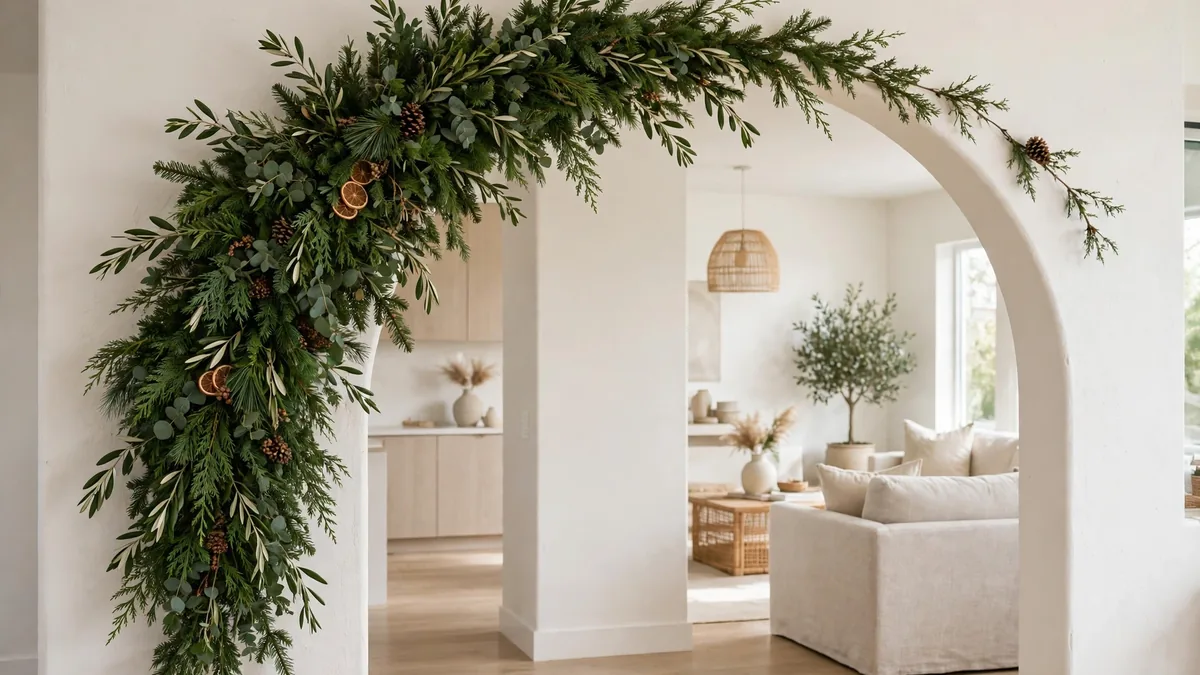
5. The one-sided arch sweep
Garland that starts thick at the top left of an arch, sweeps across, and tapers to a thin tail on the right. An arch is already a curve, so fighting it with a centred dip looks forced. Start thick where the arch meets the wall, and let the tail end about 12 inches below the spring line on the other side.
6. The minimal eucalyptus line
A slim eucalyptus garland, no ornaments, no lights, hung almost flat with just a 4-inch dip. It suits modern homes where thick cedar would look heavy, and it weighs so little that a tension rod holds it easily. Pair it with a wreath on the door itself if you want more impact from across the room.
7. The frosted modern arch
A frosted-tip garland on an arch, with white and silver ornaments spaced about 8 inches apart. Frosted tips catch light even without fairy lights, which suits a hallway with no nearby outlet. Keep the spacing even: frosted garland shows gaps more honestly than dark cedar does.
8. The ribbon-tail arch
A plain green garland on an arch with three long ribbon tails — each about 18 inches — hanging from the centre and from each side, instead of ornaments. The tails move when the door opens, giving the arch life without adding weight. Use wired ribbon so the tails hold a curl, and cut the ends at an angle.
Citrus, Brass, and Natural Ideas
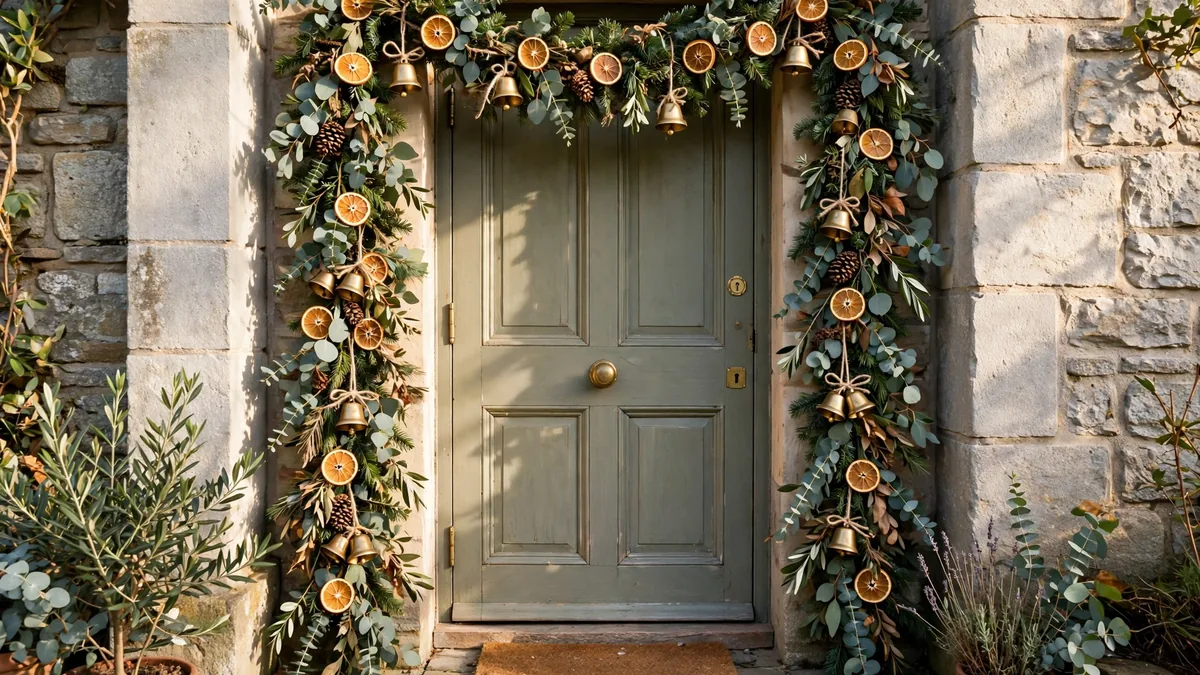
9. The dried-orange doorway
Cedar garland with dried orange slices wired in every 10 inches and small brass bells between them, hung as a single swag. The slices catch window light in a way ornaments do not. To make the slices yourself, our Dried Orange Garland DIY gives the low-oven method that keeps them golden rather than brown.
10. The citrus-and-brass arch
The citrus idea carried all the way around an arch, with brass bells clustered where the arch meets the wall and nothing in the middle. The clusters anchor the eye at the base, so the arch does not look top-heavy, and the middle stays light enough to hold its curve without extra hooks.
11. The foraged look
Mixed cedar, pine, and a few bare branches, with pinecones and no ribbon, hung full-frame. It looks gathered rather than bought, which suits rustic hallways, but it needs the most hooks of any idea here: support it every 12 inches down the sides, because bare branches catch on everything.
12. The bay and berry doorway
A bay-leaf garland with red berries wired in small clusters every 12 inches, hung as a top swag on a narrow doorway. Bay is lighter than cedar, so a 30-inch doorway needs only two hooks, and it dries gracefully, still looking good in January when cedar has started to shed.
Lit, Ribbon, and Statement Ideas
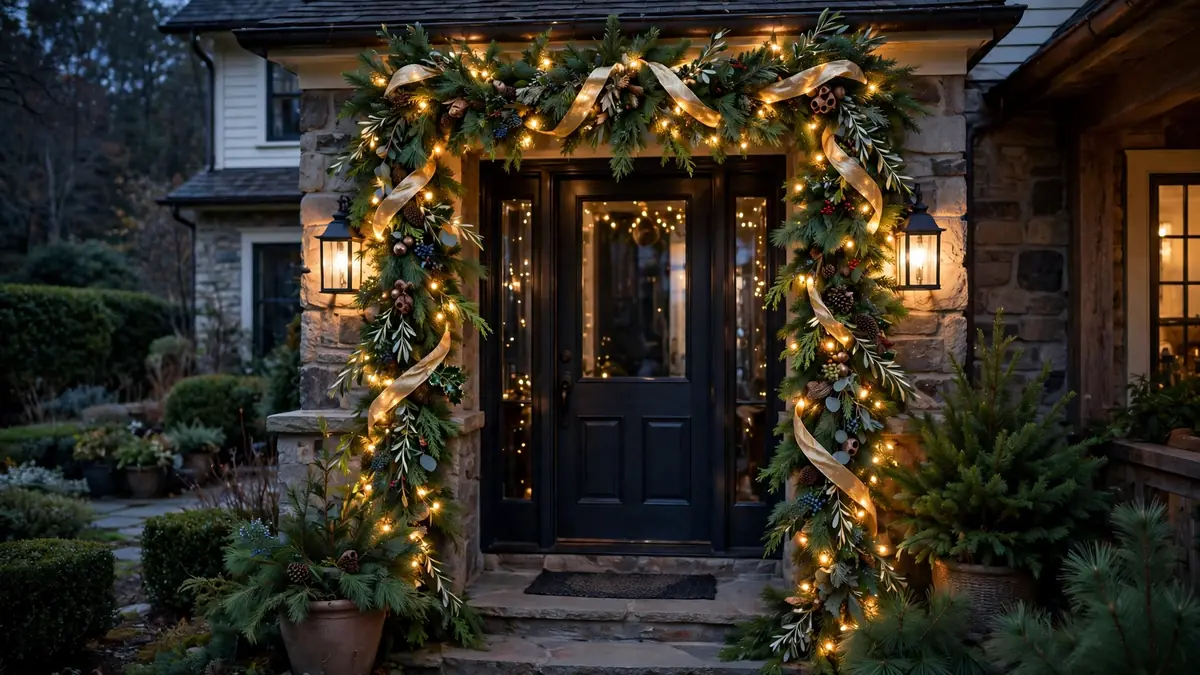
13. The warm-light evening doorway
A pre-lit garland with warm white lights, hung as a single swag and switched on at dusk. Pre-lit garland is heavier than unlit, so use three hooks even on a narrow doorway. Run the cord down the side nearest the outlet and hide it behind the garland itself, never across the walkway.
14. The velvet-knot statement
Thick cedar garland with oversized velvet knots — each bow about 8 inches across — at the two top corners and one at the centre dip, and nothing else. The knots are the decoration, so keep ornaments, berries, and second ribbons off. It works best on a wide doorway, where the knots have room to breathe.
15. The plaid and pine doorway
Pine garland with a black-and-white or red-and-black plaid ribbon, at least 2.5 inches wide, woven through it in long loops, hung full-frame. Weave it — thread it under and over the garland every 12 inches — do not just lay it on top, or it slips when the door moves.
16. The doorway that matches the entry
A garland chosen to match the entry beyond it: the same greenery as the entry console, the same ribbon as the wreath, the same metal as the lanterns. A doorway garland that fights the entry looks like an afterthought, however well hung it is. Carry one element through — one ribbon, one metal, one green — and let the rest be simple. Our Christmas entryway decor ideas for small spaces show how that matching works in tight hallways, and our Christmas window decor ideas use the same trick for windows. Our renter friendly Christmas decor ideas collect the damage-free methods used across these christmas garland ideas for doorway frames.
Mistakes That Make Doorway Garland Fall or Sag
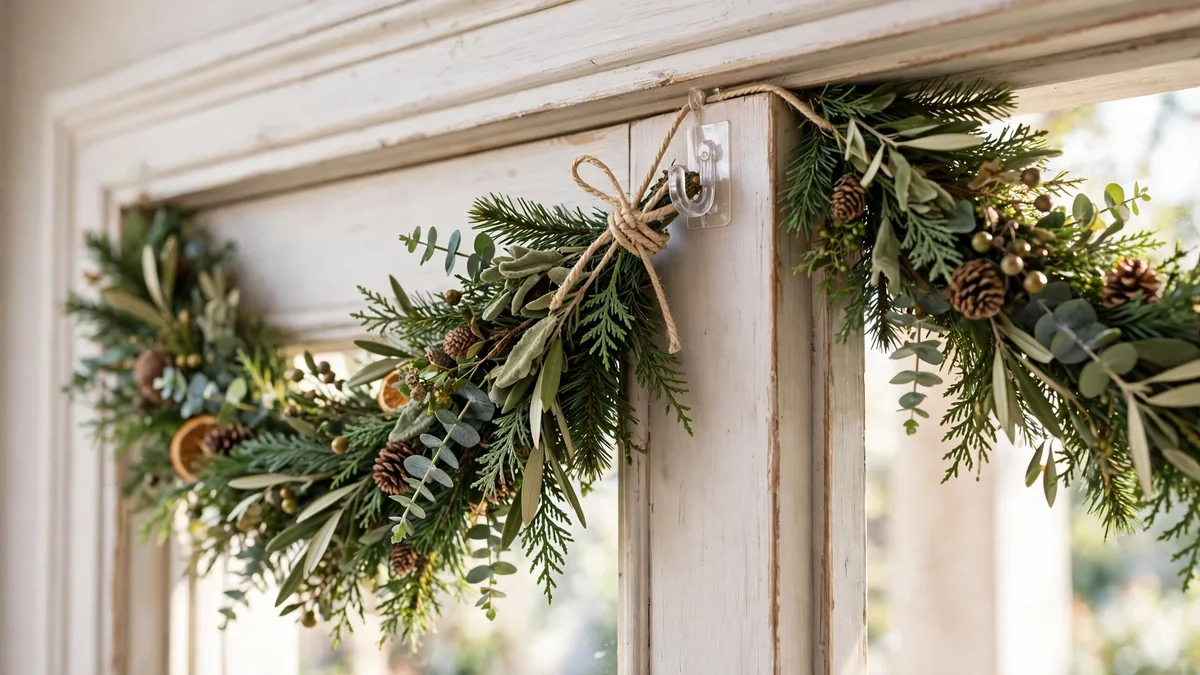
Hanging before the adhesive cures. Adhesive strips need a full hour before they take weight. Hang in the same hour you stick the hooks, and the hooks creep down the wall overnight. Stick the hooks, do something else, and hang after lunch.
One hook for a heavy swag. A single centre hook takes the whole weight and every pull of door movement. Spread it: three hooks for a top swag, one every 18 inches for a full frame, every 12 inches for a heavy or foraged garland.
Measuring the floor, not the frame. Frames taper, and a floor measurement can be an inch or more off the top. Measure at the top, where the garland sits, and use the wider of two measurements.
Ignoring the door’s swing. Garland on a doorway that opens inward needs clearance at the hinge side, and over-door hooks need the door to close. Test both with the garland in place, not before you hang it.
Stapling through lights or cords. A staple through a light cord is damage, not a fixing. Use clips, hooks, or twine ties, and discard any light set with frayed or exposed wire rather than repairing it.
Leaving the middle unsupported on an arch. An arch garland’s weight pulls toward the centre of the curve. Without a centre hook, the curve flattens into a straight line within days. One centre hook, hidden behind a bow or berry cluster, prevents it.
A Note Before You Hang Yours
The doorway I measured wrong two years ago is the same doorway I now decorate first every December, because it taught me the order that matters: measure, choose the method, then choose the style. Start with the table, pick the hanging method your frame allows, and let the idea follow. A garland hung that way does not just look better on day one. It still looks good on the day you take it down, which is the only test that counts.
Frequently Asked Questions
How do you hang garland around a doorway without nails?
Use one of three no-nail methods for christmas garland ideas for doorway frames: a tension rod for a light garland in a narrow frame, adhesive hooks (three for a top swag, one every 18 inches for a full frame) on a clean, smooth surface with a full 1-hour cure, or over-door hooks for a heavy garland on a door that closes fully.
How much garland do I need for a standard doorway?
For a standard 36-inch doorway, buy 6 feet for a single top swag, or about 16 feet 4 inches — two strands joined — for a full frame. The top-swag rule for christmas garland ideas for doorway openings is the opening width plus about 24 inches for drape and tails.
How do you keep doorway garland from falling?
Spread the weight across enough hooks, let adhesive cure for a full hour before loading it, and support the middle of every swag and arch. Most falls come from one overloaded hook, uncured adhesive, or an unsupported centre, not from the garland itself.
Can you hang garland on an archway?
Yes. Measure along the curve with a piece of string, not straight across, add about 24 inches for drape, and put a hook at the centre of the curve as well as at each side. An asymmetric sweep or a citrus-and-brass arch suits the curve better than a centred, symmetrical swag.
Sources: Command hook instructions; UC San Diego decorating safety guide; Blesser House doorway garland method.
FTC disclosure: As an Amazon Associate, Decor & Dish earns from qualifying purchases made through links on this page, at no extra cost to you.