Christmas tree skirt ideas work best when the base of the tree is chosen last in the room but first in the plan: pick the base by the tree you actually have, then by the palette already in the room, and only then by the look you like in a photograph. The direct answer is this: a full, wide tree needs a soft skirt that can spread and settle; a slim or pencil tree suits a collar or a basket that holds its narrow footprint; and a flocked or heavily ornamented tree needs a plain, quiet base so the tree itself stays the subject. Done that way, the base finishes the tree instead of fighting it, because the eye travels down the branches and lands somewhere calm.
I learned this the year I got the base wrong. I bought a beautiful, heavily patterned skirt because I loved it folded on a shop shelf, then brought it home and put it under a tree that was already full of ornaments, ribbon and lights. The skirt did not finish the tree. It started a second argument underneath it, in a different pattern, at a different scale. The next year I did the opposite: a plain cream skirt, wider than the lowest branches, with nothing else competing on the floor. The same tree suddenly looked finished. Nothing expensive had changed. The base had stopped shouting.
The Tree Base System
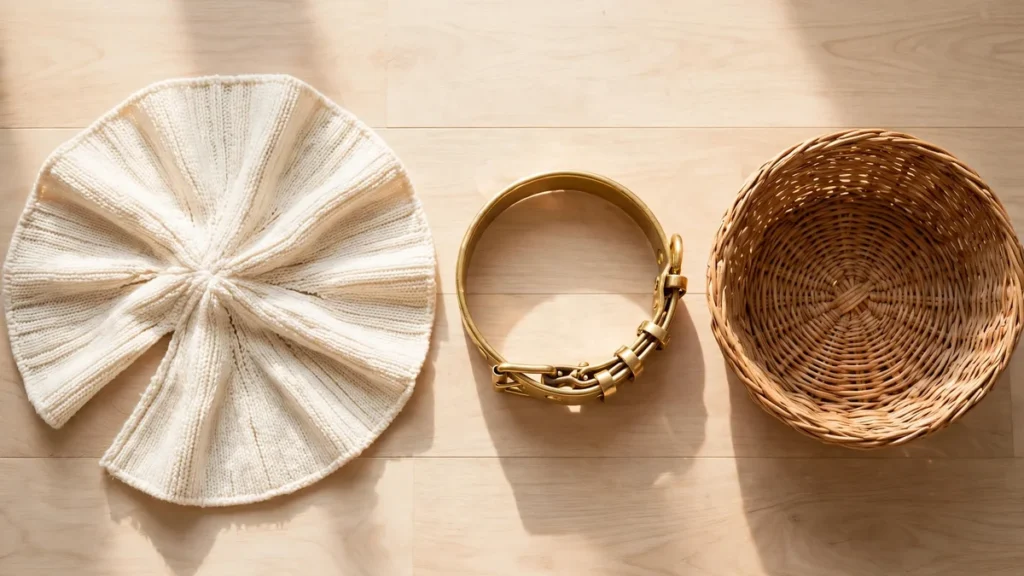
The Tree Base System has three decisions, and the order matters. First, tree type. A full traditional tree, a slim tree, a flocked tree and a tabletop tree do not take the same base, because their footprints and their visual weight are different. Second, palette. The base must repeat a colour already on the tree or in the room — cream ribbon, brass ornaments, wood tones, a sage garland — rather than introducing a new colour at floor level, where the eye is least forgiving. Third, finish: skirt, collar or basket. Each finish solves a different problem, and choosing the finish before the tree type is how most bases go wrong.
Apply the system before buying anything. Stand back and look at the tree from the doorway, not from two feet away. If the lowest branches nearly touch the floor, the base will barely show, and a simple, flat finish matters more than a decorative one. If the tree stands on a visible trunk with open floor around it, the base is a real design moment and deserves the same care as the topper. Measure the spread of the lowest branches and the height of the stand before choosing: a base that is narrower than the branch spread looks pinched, and a base that is far wider than it looks like a stage.
Skirt, Collar or Basket: Pick by Tree Type
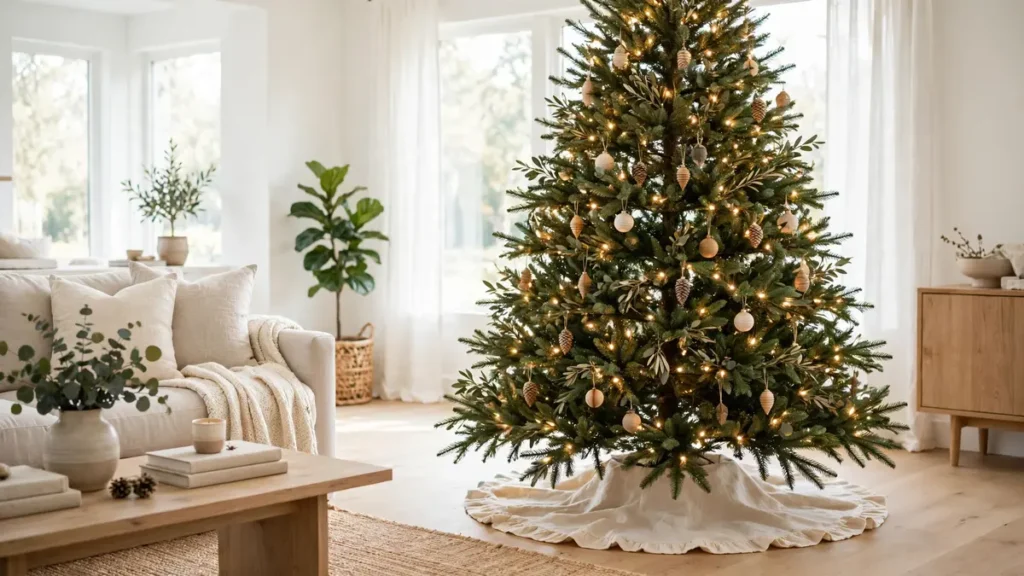
A skirt is the most forgiving finish, and the right choice for most full trees. It spreads, it softens the stand, and it gives you a place for a few wrapped gifts without a hard edge showing. Choose a skirt in one material and one colour family: quilted cotton, linen, felt or velvet in cream, natural, sage or a single plaid. Avoid a skirt that mixes three patterns at once, because the tree above it is already patterned with ornaments and lights. For a flocked tree, a skirt in cream or soft white works best, since it reads as a continuation of the flocking rather than a new idea. For a traditional green tree with a strong palette, a skirt in one of the palette colours — cream, burgundy as an accent only, or natural burlap for a cottage room — keeps the base inside the system.
A collar is the right choice for a slim tree, a pencil tree, or a tree in a tight corner. A collar is a rigid ring, usually metal or woven, that sits around the stand and hides it without spreading across the floor. It suits rooms where a skirt would bunch against furniture or a wall, and it suits modern or minimal rooms where a soft, ruffled edge would look out of place. The rule for a collar is proportion: it should be wide enough to hide the stand completely from every angle you actually see, but not so wide that it dwarfs a slim trunk. A brass or galvanised collar adds the room’s metal in one place; a woven collar adds texture without colour.
A basket is the right choice when the tree is small, when the room is cottage or rustic, or when you want the base to look like furniture rather than fabric. A woven basket, a wooden crate or a galvanised tub holds the stand, hides the trunk, and gives the tree a grounded, collected feel. The basket must be deep enough that the stand sits securely inside it, and wide enough that the tree cannot tip — never balance a large tree in a shallow basket for the sake of a photograph. For a tabletop tree, the same logic applies at a smaller scale: a small basket or wooden box, in proportion to the tree, beats a full-size skirt cut down to fit.
Match the Skirt to the Palette, Not the Other Way Round

The most common mistake with a tree base is buying the base first and then trying to make the tree match it. Reverse that. Look at the tree and the room, list the colours already present, and let the base repeat one of them. If the tree has cream ribbon and brass ornaments, a cream skirt with a brass-trimmed edge or a simple natural skirt will finish it. If the room is sage and wood, a sage skirt or a natural linen skirt with a wooden basket nearby keeps the base inside the palette. If the room already has a strong accent, let the base carry it only once: one burgundy detail, one plaid panel, one velvet bow at the front — never all three.
Texture matters as much as colour. A velvet tree does not need a velvet skirt as well, and a tree with a lot of shine — metallic ornaments, tinsel, a glittering topper — needs a matte base to rest the eye. Our Christmas mantel decor ideas use the same discipline, one layer of greenery, one layer of light, one small warm accent, and the tree base deserves the same restraint. Keep the base quiet where the rest of the room is busy: if the mantel, the staircase and the doorway are all decorated, the tree base should be the calmest surface in the room. Our Christmas garland ideas for doorway and Christmas staircase decor ideas treat those spots as finishing details, and the base works the same way.
Sizing, Layering and the Floor Around the Tree
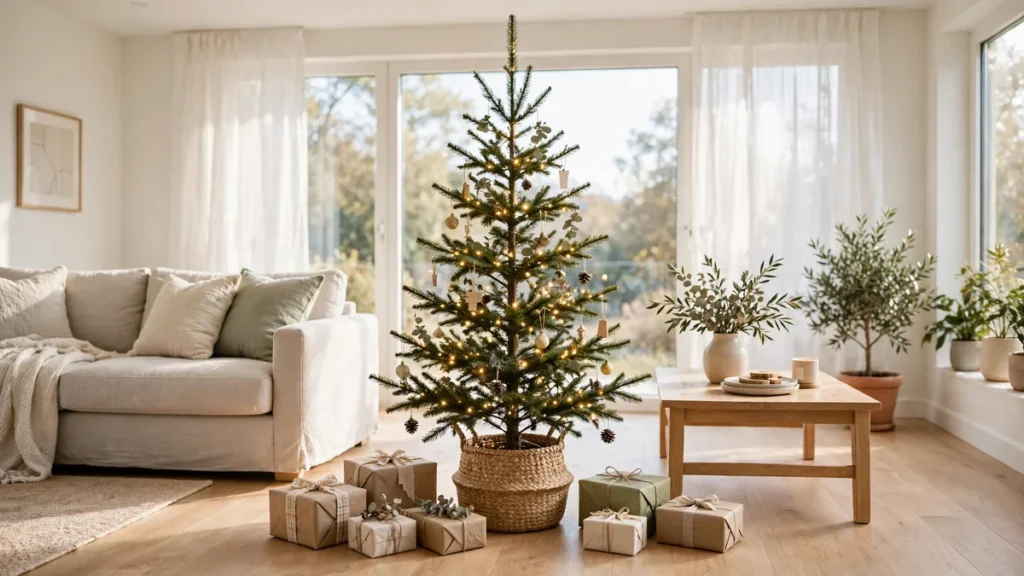
Sizing is where a good base becomes a great one. Measure the spread of the lowest branches, then choose a base that covers the stand and reaches at least to the outer edge of that spread, without extending so far that people trip over it. A skirt that ends well inside the branch spread leaves a visible ring of stand and floor, which is exactly what the base was meant to hide. A collar that is too narrow leaves the stand peeking out from one side, which the eye finds immediately. A basket that is too small for the stand is not a styling problem; it is a stability problem, and it should be replaced, not decorated around.
Layering works when it is deliberate and stops at two layers. A flat skirt under a basket or a thin linen layer under a quilted skirt can add depth, but three layers at floor level will look cluttered from the doorway. Keep the floor around the tree clear: a pile of unwrapped boxes and tangled light cords around the base will undo even a perfect skirt. If the tree is in a hallway or a passage room, the base must be flatter and tighter than in a living room, because people walk past it. Our Christmas hallway decor ideas treat narrow, high-traffic spaces as a system of their own: a collar or a flat skirt, nothing that spreads into the walkway.
Mistakes That Make the Base Fight the Tree

Most tree bases go wrong in the same few ways. First, too many textures. Velvet, sequins, faux fur, plaid and burlap in one base do not look layered; they look undecided, because the eye cannot tell which texture is the theme. Pick one texture for the base and let the tree carry the rest. Second, a skirt that fights the tree’s palette. A bright red skirt under a sage tree, a silver skirt under a warm brass room, or a patterned skirt under a heavily patterned tree will pull the eye to the floor for the wrong reason. The base should repeat the palette, not restart it.
Third, a base that is the wrong size. Too small, and the stand shows; too large, and the tree looks like it is standing on a stage. Measure first, buy second, and do not trust a photograph’s proportions. Fourth, a base that hides the tree’s best feature: a tall, stiff collar can hide the lowest ornaments on a tree whose bottom branches are its fullest. Step back and check from the doorway after placing the base, not just from beside the tree. Fifth, a base that is never finished: a skirt left half-tucked, a collar left askew, a basket with the stand still visible. Spend two minutes straightening the base after the tree is decorated.
A note before you style yours: my first tree base taught me the only rule I still use for this part of the room: decide the tree type, then the palette, then the finish, and then stop. One material, one colour family, one finish, sized to the lowest branches and straightened in the evening light. A base styled that way does not need to be expensive or elaborate to make the tree look finished. It needs to be quiet, proportionate, and inside the palette the tree already has. Start with the measurement, and let the rest of the tree do the celebrating.
Frequently Asked Questions
How big should a Christmas tree skirt be?
It should cover the stand and reach at least to the outer edge of the lowest branches, without extending so far into the room that people trip over it. Measure the lowest branch spread first, then choose a skirt, collar or basket to that measurement.
Is a tree collar or a tree skirt better?
A skirt suits most full trees because it spreads and softens the stand. A collar suits slim or pencil trees and tight corners, because it hides the stand without spreading across the floor. Choose by tree type first, not by which one photographs best.
Can I use a basket instead of a tree skirt?
Yes, if the basket is deep and wide enough to hold the stand securely and the tree cannot tip. A basket suits small, cottage or rustic trees best; a large tree in a shallow basket should be replaced with a skirt or collar instead.
What colour tree skirt goes with any tree?
Cream or natural linen goes with almost any tree, because it repeats the light in the room rather than introducing a new colour. If the tree already has a strong palette, repeat one colour from that palette instead of adding a new one at floor level.
Sources: Wayfair tree skirt and tree collar buying guides (retailer guides seen in SERP results); DIY tree skirt tutorials from small decor blogs (SERP results); general tree-base sizing guidance as described in those guides. Named as sources only; no competitor text is copied here.
FTC Disclosure: This post contains Amazon affiliate links. If you click a link and make a purchase, we may earn a commission at no extra cost to you.